ADAS Could Cut Collision Work, Pushing Repair Shops to Bring More Services In-House
Electric Vehicles Lurah Lowery 393 reads
As driver assistance improves, Justin Allen urges repair shops to prepare for fewer collisions by developing more in-house work.
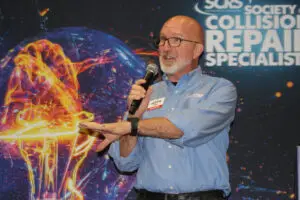
Better driver assistance could leave collision repair shops with fewer damaged vehicles to fix. Justin Allen, a regional trainer at Hunter Engineering, says shops should treat that possibility as a prompt to plan ahead: build the skills and services that can keep work inside the business as vehicles and repairs change.
Allen raised the question during the Society of Collision Repair Specialists’ IDEAS Collide Showcase, held Nov. 4 at the SEMA Show in Las Vegas. He was one of seven speakers at the event. His central point was that shops shouldn’t wait for a sharp drop in collision work before considering how their business might adapt.
Fewer impacts, more involved repairs
Advanced driver assistance systems are changing what collision repair requires, Allen said, and continued improvements could mean fewer vehicles involved in collisions. He contrasted the technology’s current reach with the ubiquity of cell phones: about a third of vehicles on the road use ADAS, while cell phones are now common in people’s pockets. He also recalled that more than half of households had cell phones by the early 2000s, connecting the spread of phones with driving distraction.
Allen described collision repair as an industry built around vehicle impacts. He pointed to the first automobile collision in 1891 and argued that the trade has had a long history of relying on damaged vehicles to generate work. That history can make a possible decline in collision volume hard to picture. But shops already face a different mix of demands: fewer collisions may sit alongside repairs that call for more technology and higher costs.
That combination matters. A lower number of damaged vehicles doesn’t automatically mean less work on every repair, especially when the vehicles that do arrive require more involved service. Allen’s point was that shops have to consider both sides of the shift: the possibility of fewer collision jobs and the greater technical demands associated with modern vehicles. The balance will vary from shop to shop, but assuming that past volumes will continue is a poor substitute for preparing.
He didn’t offer a timetable for ADAS adoption or forecast how quickly collision frequency might change. Instead, he framed the challenge as a strategic question for repairers: what work can they perform themselves as the trade evolves, and how can they make that capability part of the business?
Bring more work inside the shop
Allen’s practical suggestion was to look for services that shops currently send elsewhere and assess whether they can bring them in-house. He tied that opportunity to a broader shortage of people able to do skilled automotive work. If qualified labor is difficult to find across the industry, developing the people and processes to handle additional work could help a shop serve customers while keeping more of the repair process under its own roof.
That takes more than deciding to offer another service. Shops need to identify which tasks fit their operation, then consider whether they have the staff, training and equipment to complete them well. Allen didn’t name a particular service or prescribe a single expansion plan. His advice was to start the discussion early, before changing repair needs force a rushed response.
There’s a practical tension here: adding capability can take effort at a time when the future volume of collision work is uncertain. Yet waiting also carries a cost if more work becomes technically demanding or if existing services increasingly depend on outside providers. A deliberate review of the jobs a shop sublets, the skills its team can develop and the equipment those jobs require gives owners a way to turn a broad industry shift into specific questions they can evaluate.
Allen urged shop operators to approach disruption with energy rather than fear. He said the industry still has opportunities to bring good work into repair businesses, even if the exact opportunity will differ for each shop. His message was to think creatively, plan proactively and avoid being caught unprepared as ADAS improves and the repair mix changes.
For collision repairers, the useful takeaway is not a prediction that accidents will disappear. It’s a reason to examine how dependent the business is on collision volume alone. Shops that understand their current subcontracted work and the capabilities they could build will be better placed to respond as vehicle technology changes what customers need repaired.
Featured image: Justin Allen of Hunter Engineering speaks during the 2026 SCRS IDEAS Collide Showcase on Nov. 4. (Lurah Lowery/Repairer Driven News)