Why Small Trucking Fleets Are Shrinking as Owner-Operators Lease On
Electric Vehicles Adam Wingfield 909 reads
Small-carrier tractor counts have fallen about 9% since 2023, as rising costs push equipment toward larger fleets through lease-ons and sales.
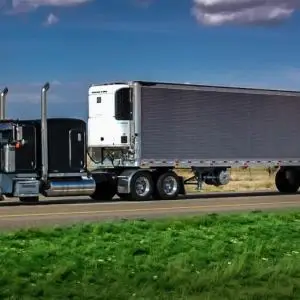
The smallest trucking fleets are losing tractors, but much of that equipment is still on the road. The shift is increasingly about who operates the truck and whose authority it runs under: some owner-operators are leasing on with larger carriers, while others are selling their equipment to fleets better placed to manage rising costs.
That movement helps explain why the decline in one-to-six-truck carriers can coincide with growth in larger fleet tiers. For drivers weighing independence against a lease-on, the key issue is the margin left after fuel, insurance and other costs—not simply whether freight rates are improving.
A retreat from the smallest tier
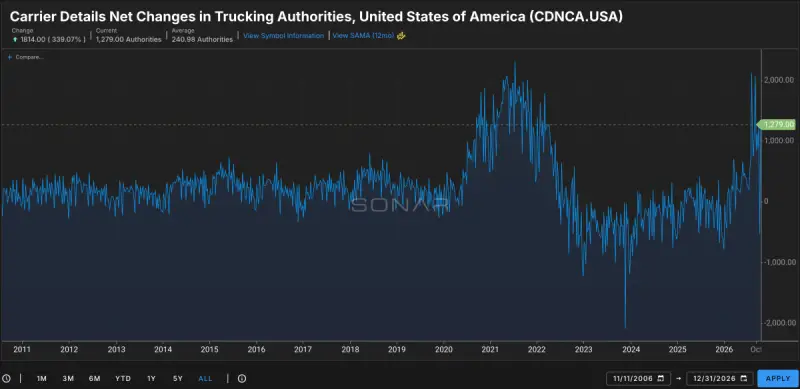
FreightWaves SONAR counts 362,033 tractors at carriers with one to six power units. That is below the segment’s five-year average of about 378,800 and its 12-month average of roughly 364,960. The count reached nearly 398,000 in the first half of 2023, after a surge of new entrants during the pandemic-era freight boom, then fell with few interruptions.
The decline amounts to about 36,000 tractors, or roughly 9% of the peak. It has unwound much of the boom, though it doesn’t show that all those trucks have stopped hauling. A significant share may have shifted into another fleet-size category as operators changed how they run their businesses.
The one-to-six-truck band remains the broadest part of the carrier base by registration count. The FMCSA census lists more than 1.8 million active carrier registrations in that range, including private and intrastate operators as well as for-hire haulers. That makes the shrinking tractor count a change at the market’s widest base, not a retreat from a small niche.
Costs are tightening the margin
Operating a truck became more expensive in 2025. The American Transportation Research Institute put average marginal operating costs at $2.336 per mile, a record in its data. Driver pay accounted for about 82 cents per mile, with fuel at roughly 48 cents.
Fuel costs then rose sharply in 2026. The U.S. on-highway diesel average reached $6.127 a gallon for the week of November 9, above its previous record. At six to seven miles per gallon, diesel at more than $6 a gallon works out to roughly $1 per mile in fuel. That is close to twice the earlier fuel cost cited in the analysis, added to an already high operating-cost base.
Small carriers often have limited protection from a fuel spike. Fuel surcharges are common on dedicated or committed contract lanes, where the surcharge can change with the weekly diesel average. Spot-market prices, by contrast, are generally quoted as a single all-in rate. An owner-operator relying on load-board freight may have no separate surcharge to adjust when fuel jumps, leaving the operator to absorb the increase until the rate can be renegotiated.
A larger fleet with negotiated contract freight may recover part of the same increase through its surcharge program. The difference is material: both carriers pay more for diesel, but the spot-dependent operator may have less ability to pass that cost along.
Insurance adds another burden. Premiums averaged about 10.6 cents per mile in 2025, up nearly 4% from the year before. Operators with one or two trucks also have less room to spread insurance costs or negotiate terms than a larger fleet. Tolls, maintenance and driver benefits were among the other cost categories that rose quickly in ATRI’s figures.
Rates are firmer, but costs still matter
The pressure on small operators isn’t simply that freight rates are falling. Spot van and reefer rates strengthened through 2026, and contract pricing is forecast to rise into the next year; some dry-van estimates project double-digit increases. Freight volume, however, has remained roughly flat, with SONAR’s Truckload Volume Index near its average rather than showing a sharp increase.
Better rates can help, but the rate on a load doesn’t tell the whole story. An owner-operator may capture a stronger spot price and still see the fuel bill rise faster than the revenue per mile. A carrier with contract freight and a surcharge can benefit from improving rates while recovering some of the fuel increase. That combination gives larger fleets more room to protect their operating margin.
For an independent operator, a move to another fleet can therefore be a way to keep driving while reducing the burden of finding freight, carrying insurance and managing the administrative work of running an authority. It changes the business arrangement, but it doesn’t necessarily take the truck or driver out of service.
Where the tractors are going
The census data shows a rising share of leased tractors as fleet size grows. Owner-operators have about 6.9% of their tractors listed as leased. The share rises to 18.2% among fleets with seven to 19 trucks, 31.6% in the 20-to-100-truck band, and more than 40% among fleets with 101 to 999 trucks.
Leased equipment can mean an owner-operator has brought a tractor into a larger carrier while leasing on. It can also mean the fleet leases equipment from a full-service provider such as Penske or Ryder. The figures don’t distinguish between those arrangements, so they can’t show how many former independents have joined a fleet. They do show that larger carriers operate a growing proportion of their equipment without owning it outright.
In the 20-to-100-truck band, the census lists more than 217,000 term-leased tractors alongside roughly 466,000 owned tractors. That owned-tractor count is close to SONAR’s separate estimate of 470,402 tractors for the same fleet-size range, providing a useful comparison between the two datasets.
Lease-ons are only one route. Some departing operators sell their trucks, and larger fleets can buy used equipment when it becomes available. Either way, a truck leaving an owner-operator’s business can keep hauling under a larger operation.
Why the middle can absorb the shift
Carriers with 20 to 100 trucks are few compared with the smallest tier, but they operate a large amount of equipment. About 44,500 active carriers fall into this band—less than 2% of all carriers—yet they run roughly 1.75 million power units.
That scale can help them spread fuel, insurance and maintenance expenses across more trucks. They may also be able to negotiate fuel-surcharge programs, buy diesel in volume and maintain a freight base that is harder for a single operator to secure alone. At the same time, a regional fleet of this size can retain more flexibility than a very large operation.
Those advantages help explain why this tier can serve as a landing place for capable operators who no longer want to carry the full cost of an independent business. The driver may keep driving, and the tractor may keep earning, while the carrier takes on more of the freight and operating structure.
What the choice means for owner-operators
The data doesn’t establish that independent trucking has no future. It does show that small operators have less room for mistakes when key costs rise and they lack either scale or reliable access to contract freight. Operators who know their cost per mile, build direct shipper relationships and manage their equipment carefully are better placed to judge whether independence still works for them.
Leasing on can trade some control for access to a larger carrier’s freight and cost structure. Selling the tractor is another possible outcome, while staying independent leaves the operator responsible for covering fuel, insurance and other expenses from the rates they can secure. Which arrangement makes sense depends on the individual business; the fleet data alone can’t settle that decision.
The clearest industry signal is the movement of capacity up the fleet-size ladder. With the one-to-six-truck tier down about 9% from its 2023 peak and leased equipment accounting for nearly a third of tractors in the 20-to-100 band, consolidation is changing how capacity is operated. For an owner-operator, the practical question is whether the truck can earn enough under their own authority—or whether a larger carrier offers a more workable way to keep it moving.
The figures draw on FreightWaves SONAR tractor counts by fleet size and its Truckload Volume Index, alongside an FMCSA Company Census File snapshot dated November 9, 2026. Operating-cost and insurance figures come from ATRI’s 2026 Operational Costs of Trucking report. The diesel figure is the U.S. on-highway average for the week of November 9, 2026. Census power-unit totals are self-reported and include private and intrastate carriers; term-leased tractor totals include both owner-operator lease-ons and equipment leases.