NYC Delivery Protection Act Faces Changes as Amazon DSPs Push Back
Electric Vehicles John Kingston 516 reads
New York City’s proposed delivery rules may be reshaped to address worker safety while limiting the risk to locally owned delivery firms and jobs.
New York City’s proposed Delivery Protection Act appears likely to pass by the end of 2026, but its original approach to Amazon’s delivery network may be substantially revised. The central question is whether the City Council can agree on rules that address worker protection and street safety without forcing a major change to the structure of local delivery businesses.
The proposal, introduced in February and backed by Mayor Zohran Mamdani, would require “last mile facility operators” to obtain a city license. It would also restrict how those operators work, including a ban on third-party subcontracting. Amazon and its Delivery Service Providers (DSPs) argued that those provisions could upend the existing arrangement: independent, locally owned DSPs contract with Amazon and employ the workers who deliver its packages.
New York City has about 100 Amazon DSPs. Under the bill as first drafted, the licensing rules and subcontracting ban could leave Amazon needing to buy those businesses and employ their workers directly. That would change who issues workers’ W-2 tax forms and who is responsible for employing them. The licensing provision also gives the city commissioner authority to suspend or revoke a license, after notice and a hearing, if an operator fails to follow applicable requirements.
Negotiations point to a narrower version
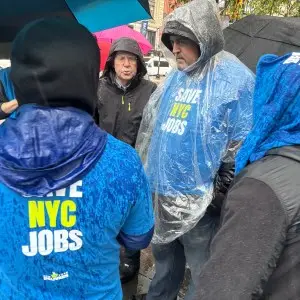
At a City Hall rally hosted by New York Delivers, a coalition that includes Amazon, DSP owners and business leaders argued that the proposal needs changes. The gathering followed a similar April rally held before the only hearing on the measure. Supporters of the legislation, including the Teamsters, have also rallied at City Hall, and the two sides have taken opposing positions on the proposal’s likely effects.
One visible difference between the groups’ recent events has been the presence of City Council members. Council members, beyond sponsor Tiffany Caban, have attended Teamsters rallies. They have not appeared at New York Delivers events. A council member who had supported the measure recently withdrew that backing, drawing attention to the prospect of job losses.
Jessica Walker, president and CEO of the Manhattan Chamber of Commerce, said council members are discussing what the final version should contain. She told FreightWaves that the negotiations are taking place among council members, who need to determine a workable approach together. Her comments point to a likely compromise process inside the council rather than a simple contest between the bill’s supporters and outside opponents.
Walker said the goal should be a strong measure addressing street safety and worker protection, but she argued the current draft does not accomplish that. She also said the city already has multiple agencies involved in worker safety, along with federal involvement, and called for stronger enforcement where existing protections are not being applied.
Small business and job concerns
All five borough-based chambers of commerce oppose the bill as written. They emphasize that DSPs are local small businesses, with more than a quarter led by people of color, and that they employ thousands of people across the city. Some owners are veterans. Their argument is that a policy aimed at delivery practices could eliminate businesses rooted in the boroughs if it requires Amazon to absorb the contractors.
Opponents also question whether a requirement to hire workers who have been let go by a delivery company would hold up in court. They say the licensing system could create another employment risk: if a company loses or cannot renew its license, workers could be left without jobs while the process unfolds.
Another possibility raised by critics is that Amazon could shift some warehouse operations outside city limits. In their examples, activity could move from Queens to Nassau County or from the Bronx to Westchester County, with DSPs collecting packages from facilities just beyond the city. That scenario would preserve delivery contractors while moving some of the activity the proposal seeks to regulate across a border.
Brooklyn Chamber of Commerce president and CEO Randy Peers challenged the idea that independent contractors should face different treatment from other city subcontractors. At the rally, he cited 1,137 subcontractors used by the city Department of Transportation, including 85 in courier trucking or logistics, and $458 million in subcontracted work. Peers argued that the same business model should be acceptable for private delivery work if it is used by city agencies.
What the speaker’s position could mean
City Council Speaker Julie Menin is another key figure because the measure has enough co-sponsors to pass if it reaches the floor. A New York Times report said Menin was concerned the proposal could cost the city jobs and prompt Amazon to raise prices. In a statement to the Times, however, she expressed broad support for a licensing framework, saying large online retailers should face rules intended to support fair pay, worker protections and more responsible delivery practices, including reducing vehicles idling on city streets.
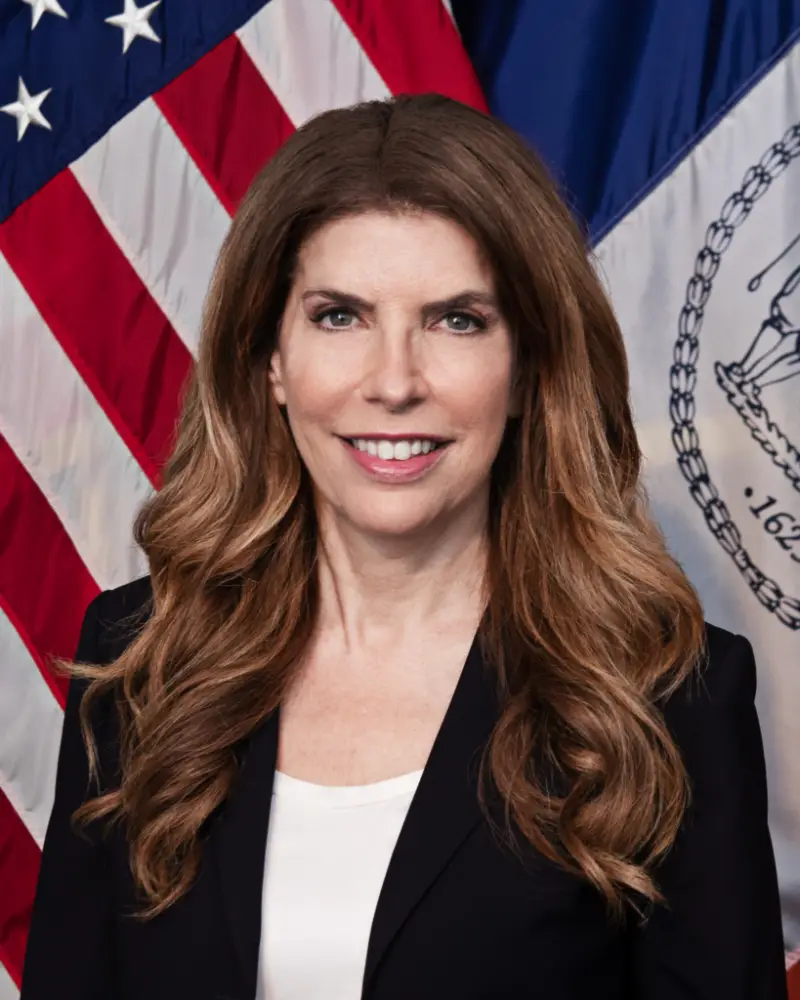
Council speaker Julie Menin
The gap between concern about the bill’s economic effects and support for licensing helps explain why negotiations matter. Supporters may be looking for a version that can pass while avoiding provisions most likely to trigger a long court fight. If that effort succeeds, the final measure could fall short of the original draft’s most far-reaching consequence: effectively requiring Amazon to purchase the DSPs.
Delivery quotas and enforcement in focus
One possible area for compromise is the delivery pace expected of DSP drivers. Walker suggested that quotas requiring drivers to complete very high numbers of deliveries within a set period could contribute to street safety problems. That would shift some attention from who owns the delivery company to the conditions under which drivers work and how those conditions affect activity around warehouses and on city streets.
Walker said studies point to street safety, especially near warehouses, as a major concern. She said the chambers are proposing other ways to address those issues while avoiding the elimination of roughly 100 locally owned businesses. A final draft that focuses more directly on delivery practices, worker protections and enforcement could offer a route to regulation without mandating a wholesale change in employment structure.
FedEx shares the contractor structure
The debate also touches FedEx, whose Independent Service Providers (ISPs) operate under a contractor model similar to Amazon’s DSPs. FedEx does not own those businesses, and some owners may also own one or more Amazon DSPs. The company belongs to New York Delivers, although rallies opposing the proposal have focused far more on Amazon-branded businesses and workers. Supporters of the measure, in turn, have seldom highlighted FedEx.
FedEx said it is working with the New York Delivers coalition on the proposed legislation. A company spokeswoman described last-mile delivery facilities as an increasingly essential part of New York City’s shipping and logistics infrastructure as e-commerce has grown, and referred questions about the measure to the coalition.
The New York proposal is drawing attention beyond the city. A similar approach is being proposed in Chicago, while no other cities are identified as pursuing the same model. If New York adopts a revised version, its practical effects could shape how other cities assess rules for delivery firms that rely on independent contractors. For now, the most consequential details remain unsettled: what duties a license will impose, how delivery expectations will be addressed and whether the final framework can withstand a court challenge.