Fuel Prices Top Trucking Concerns as Drivers and Carriers Split on Priorities
Electric Vehicles John Kingston 454 reads
Fuel prices lead ATRI’s trucking survey, while drivers and carriers rank parking, staffing, pay and liability concerns differently.
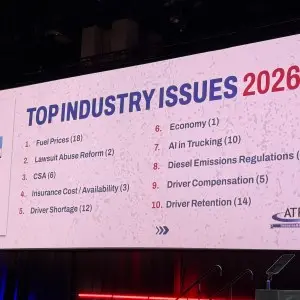
Fuel costs have returned to the top of trucking’s concerns, with drivers and carriers both placing them near the top of the list in the American Transportation Research Institute’s annual survey. The split in their other priorities is just as telling: drivers emphasize parking and day-to-day working conditions, while carriers focus more on liability, staffing and insurance costs.
Fuel prices ranked first among drivers and second among carriers, making them the leading issue overall. That result suggests higher diesel costs remain a problem for carriers even when fuel surcharges can pass some of the expense to customers. Surcharges may help offset fuel bills, but the survey indicates they don’t remove the pressure from carrier operations.
ATRI, the research arm of the American Trucking Associations, presented its top 10 list at the association’s annual Management Conference & Exhibition in Charlotte. This was the fourth time in the survey’s 22-year history that fuel prices reached the top overall spot. The issue had dropped out of the top 10 in 2024 and 2025 after last appearing in 2023, when drivers ranked it third and carriers put it fifth.
Diesel costs return to the forefront
The price backdrop helps explain the renewed concern. The Energy Information Administration’s weekly retail diesel series reached $5.341 per gallon on Oct. 24, 2022. Prices eased in 2023 but stayed above $4 per gallon until May, then rose above $5 for much of August through November.
This year’s high in that weekly series was $6.529 per gallon on Sept. 22, the highest level in the series’ history. AAA’s daily average retail diesel price also reached a record in September. For fleets, fuel prices affect operating expenses directly, while drivers feel the cost through the economics of running a truck and the pressure it can place on compensation and business decisions. The survey’s rankings show the issue has again become hard to set aside.
Safety scores carry added weight
Carrier safety scores also ranked high, placing fifth among carriers and third overall. ATRI said the category has appeared in the top 10 in 16 of the 17 years since the scoring system first entered the survey in 2010. This year’s ranking was its highest since 2015.
The heightened attention follows a court ruling in the Montgomery case, which has sharpened questions about how brokers document their decisions when selecting carriers. The survey report says brokers may need evidence that they hired the safest carriers to defend against negligent hiring claims, and it identifies carrier scores as one possible form of documentation.
That creates a practical tension. The report calls for attention to differences in how safety rules are enforced and to geographic variation in results, while also describing scores as useful records in a dispute over carrier selection. A score can therefore matter to industry decision-makers even as respondents question how consistently it reflects safety across different places and situations.

From left to right at the ATA MCE meeting, revealing the ATRI top 10: Rebecca Brewster, outgoing head of ATRI; Ben Banks, president of TCW; Jason Damon, Convoy Systems; and Gary Johnson, Motive.
Drivers and carriers see different pressure points
Truck parking ranked second for drivers, but didn’t make the carriers’ top 10. The contrast points to a gap between the daily experience of finding a place to stop and the operational concerns that fleet managers prioritize. Efforts to improve parking availability haven’t made it a less pressing issue for drivers.
Compensation remains a consistent concern for drivers. It ranked first in 2023, second in 2024, first in 2025 and third this year. Carriers included driver compensation at number nine, its first appearance in their top 10 in four years. Driver shortage showed the reverse pattern: it ranked third for carriers and didn’t make drivers’ list.
Other differences reflect how each group encounters the work. Drivers placed broker issues eighth and delays at customer facilities seventh. Neither category appeared among carriers’ top 10 concerns. Lawsuit abuse ranked second overall for a second straight year and first among carriers, but it didn’t make the drivers’ list.
Liability costs and insurance remain connected
ATRI’s respondents pointed to several approaches for addressing lawsuit abuse. They favored state-level limits on non-economic or punitive damages in truck-involved crashes, and changes to claims based on “phantom” medical damages. ATRI uses that term for awards calculated from a provider’s original bill rather than the amount actually paid for care. The report says inflated medical costs can raise settlements and verdicts, and notes that Florida and Georgia have passed measures addressing those claims.
Respondents also identified third-party litigation funding as a target. In these arrangements, an outside attorney or group provides upfront money to support a case. The concern fits into a broader focus on the cost of liability, which also appeared in the survey’s insurance ranking.
Insurance cost and availability ranked fourth overall. ATRI expects the effects of the Montgomery ruling to become more apparent and says insurance rates are likely to rise for both carriers and brokers. Its leading recommendation is a framework that could encourage insurers to lower premiums when drivers and carriers adopt proven safety technologies.
The survey captures an industry managing several pressures at once: volatile fuel costs, uneven access to parking, workforce concerns and questions about liability and insurance. Fuel now leads the shared list, but the sharply different rankings make clear that operational decisions and drivers’ working lives don’t always point to the same priorities.