Austin Cindric Wins Ford Mustang Dark Horse R’s Daytona Debut
Electric Vehicles Dylan Spaulding 319 reads
Cindric beat Robert Noaker in a close Daytona race as the Dark Horse R made its first track appearance ahead of Mustang Challenge competition.

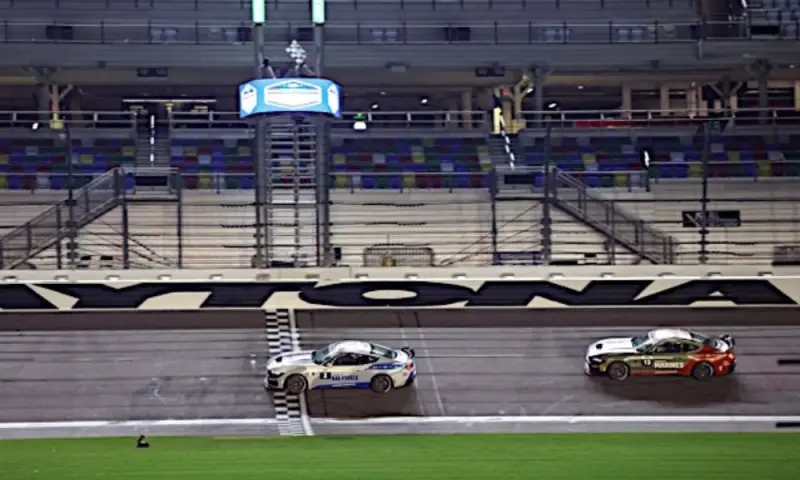
Austin Cindric’s late pass on Robert Noaker gave Ford’s Mustang Dark Horse R a close-fought first race appearance at Daytona International Speedway. The 2022 Daytona 500 winner took the inaugural Ford Proud To Honor: Veterans Day Classic, a 30-minute contest that offered an early look at the car before its Mustang Challenge North America competition debut in January.

Cindric and Noaker traded the lead several times, with Cindric making the decisive move in the final five minutes. The win was Cindric’s first on the Daytona road course since 2020, when he won the UNOH 188 in what was then the Xfinity Series. This time he drove the No. 2 Air Force Mustang Dark Horse R.
The race brought together competitors from Mustang Challenge North America and Mustang Cup USA, putting drivers familiar with the single-make field into a contest with a high-profile NASCAR visitor. The result made the car’s first Daytona outing more than a demonstration: the lead changed hands repeatedly, and the winner had to settle the contest on track.
Noaker pushed Cindric to the finish
Noaker finished second after challenging for the lead throughout. A two-time Mustang Challenge North America champion, he had won every race he entered in the Dark Horse R since 2024, including a dominant 2025 campaign. Daytona ended that run, though Noaker said he expected Cindric to be competitive.
Cindric had raced at Daytona in the 24 Hours and in GT4 machinery, and had substantial road-course experience. Noaker said he was impressed by how quickly Cindric adapted, especially with only four practice laps before qualifying. That limited preparation made the close pace between the drivers a notable part of the evening.
“Robert did a hell of a job,” Cindric said. He called the battle enjoyable and said taking part in the event gave him a chance to recognize veterans and service members. For Noaker, the contest showed how a driver arriving from another series could quickly join the fight in a car and format new to him.
A different feel from modern prototypes
The Dark Horse R’s H-pattern gearbox stood out to drivers used to contemporary race cars with paddle shifts. Logan Sargeant, making his first start in the car, said the shifting style was unfamiliar compared with the machinery he has driven during his career. He enjoyed racing against a varied group of competitors, but looked forward to returning to Hypercar testing and said he preferred paddles.
Joey Hand also described the car as a change of pace. Though he has driven the Ford GT and current Mustang GT3, this was his first time in the Dark Horse R. The car uses an H-pattern shifter and clutch rather than paddle shifting, automatic downshift blipping and flat-shift upshifts. Hand said that combination brought back the feel of GT cars from about 12 years ago: less downforce and more sliding.
That character gives the Dark Horse R a distinct role alongside the more advanced cars these drivers know. It asks them to manage shifts and the car’s movement in a more hands-on way, while placing experienced drivers from different backgrounds in the same field. For buyers and enthusiasts watching Ford’s racing program, the Daytona run also offered an early view of how the model behaves in competition before its January series debut.
Teams and drivers across Ford’s program
Several established teams prepared and operated the entries, which were themed for service branches. Round 3 Racing, a recent Dark Horse class champion, ran both Army cars. Capaldi Racing fielded the Marines and Navy entries, Robert Noaker Racing handled the Air Force and Space Force cars, and TPC Racing prepared the Coast Guard entry.
Frankie Muniz was taken to a local medical facility after an incident in practice. His No. 30 Air Force Mustang became lodged beneath a tire barrier in the infield section of the road course. He was later released and replaced for the race by Ford Racing Junior Team driver Jenson Altzman. Muniz said he was disappointed to miss the event, but was “a little sore” and credited the Mustang with protecting him.
Ford also used Wednesday’s activities to show its Mustang Dark Horse SC, a track-focused version of the road-going Dark Horse SC and the next step in the company’s NASCAR competition machinery. Hand helped with its debut at the speedway. Ford Motor Company CEO Jim Farley drove the Dark Horse SC pace car during warmup laps before the evening race.
Joey Logano, meanwhile, said he would be open to taking an opportunity to race in the Rolex 24 if one came up. His comment added another sign of the event’s crossover appeal, with drivers from different parts of Ford’s racing program sharing the Daytona setting.
Daytona activity continues
Round 3 Racing was set to remain at Daytona for the HSR Classic 24. Team owners Buz and Brad McCall, a father-and-son pair, planned to share the No. 997 2007 Porsche 997 GT3 Cup/3.6. TPC Racing owner Michael Levitas was also due to return to the cockpit, driving the No. 36 Type 996 Porsche 911 to mark the 20th anniversary of the team’s GT class win in the 2006 Rolex 24. Levitas shared that car with Spencer Pumpelly, Randy Pobst and Ian Baas; they finished ninth overall.
Ford hopes to make the Veterans Day Classic an annual gathering. Caroline Morales, Ford Stakeholder Advocacy communications director, said the company wanted a recurring moment around Veterans Day to bring people together, following an event it hosted with TikTok the previous year. She said Ford was working with NASCAR on how future editions might take shape, while acknowledging that the plan involved several factors.
The race’s clearest measure was its on-track story: a close fight, a late winning pass and a first Daytona outing for the Dark Horse R. Its next test will come when the car enters Mustang Challenge North America in January.