Joey Hand Says Mustang Dark Horse R Delivers a Throwback Feel at Daytona
Electric Vehicles Dylan Spaulding 605 reads
Hand’s first Dark Horse R drive brought H-pattern shifting and lower-downforce handling, as he prepared for Daytona alongside Ford’s NASCAR drivers.

Joey Hand’s first drive in the Mustang Dark Horse R put him in a different rhythm from the Ford GT3 machinery he knows: an H-pattern gearbox, clutch work and a car that moves around more under cornering. He called the experience a “throwback feel” ahead of the Proud To Honor: Veterans Day Classic at Daytona International Speedway.

The two-time Rolex 24 at Daytona winner had been scheduled to test the Dark Horse R while working on the Mustang GT3 program, but that session never happened. He arrived at the Daytona event without prior seat time in the car, and had to get acquainted with it before racing. The contrast with today’s more automated GT machinery was immediate.
A different shift routine
Hand’s current race cars use paddle shifters, automatic rev-matching on downshifts and flat-shifting on upshifts. The Dark Horse R instead asks the driver to move through a traditional H-pattern, including cross-gate changes such as fourth to fifth, and to use the clutch. The car retains ABS, but the transmission and shift routine put more of the work back in the driver’s hands.
There’s a rev-matching feature to smooth downshifts, so Hand didn’t need to heel-and-toe. He still had to brake with his right foot and adapt to how the car responded under braking. His first task was to learn how much pressure he could apply and how the brakes felt, while also getting comfortable with the manual shifts.
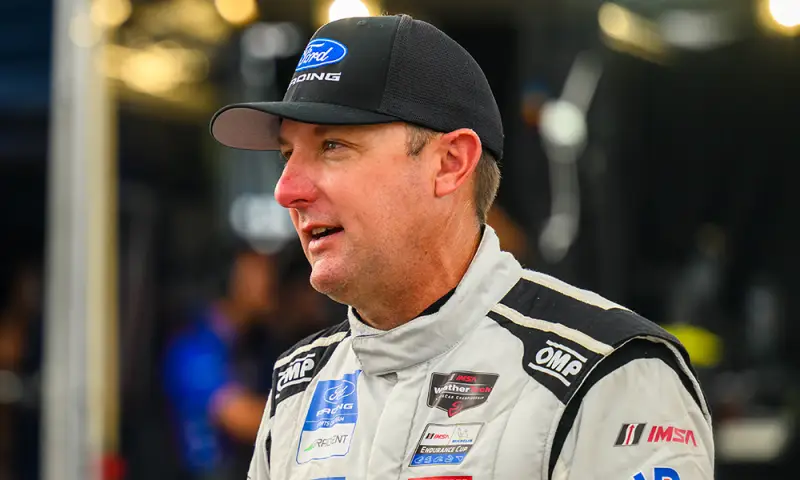
That combination makes the Dark Horse R feel distinct from the Mustang GT3 Hand has been developing and driving. The transmission requires more deliberate input, while the car’s lower downforce means it slides more readily. Hand compared the handling to GT cars from roughly 12 years ago, when drivers had less aerodynamic grip to rely on. The result, in his view, is a more familiar challenge for drivers who came up with older GT machinery and a fresh adjustment for those used to paddle-shift cars.
Helping NASCAR drivers make the switch
Hand was also sharing advice with Ford NASCAR drivers, many of whom were preparing for their first sports car starts at the event. He said some of his guidance was requested and some was volunteered. His experience gives him a useful point of reference as the group moves from stock cars to a different type of race car, where braking, shifting and the car’s willingness to slide demand their own adjustments.
He has spent time working in the simulator with Layne Riggs and Brad Keselowski. Keselowski was also Hand’s teammate when Hand drove for him in the Cup car in Chicago. That familiarity helped create an easy working atmosphere among the Ford drivers as they prepared to race together at Daytona.
The friendly coaching doesn’t mean Hand has set aside competition. He said the drivers want to win and want the trophy, while also recognizing the event’s purpose: honoring veterans. Hand described himself as proud to take part and grateful that Ford selected him for the field. He also made clear that he wasn’t holding back useful advice from the other drivers, even though they would be racing against one another.
Ford’s wider racing program
For Hand, the Daytona appearance is another chance to represent Ford and stay involved in car development, a part of racing he says ranks just behind driving. He spoke about the breadth of Ford’s programs, naming FIA Supercars, GT3, GT4, Hypercar, Formula 1 and NASCAR. His interest extends beyond racing a finished car: he enjoys working on ways to make the cars faster.
That development focus makes the Dark Horse R drive more than a one-off change of machinery. Learning how its manual gearbox, braking and lower-downforce balance differ from the GT3 gives Hand another set of behaviors to assess and communicate to other drivers. At Daytona, the immediate task is to adapt quickly and race hard; the longer-running appeal for Hand is the opportunity to understand how a different car works and help improve it.
With his first Dark Horse R laps coming just before the event, Hand’s early impression centers on the extra driver input and the looser feel through corners. Those qualities separate it from the more automated, higher-downforce cars he regularly drives, and make the Daytona outing a test of both adaptation and racecraft.