Death Proof’s 1970 Chevy Nova: The Real Stunt Car and Its Life After Hollywood
Electric Vehicles Eric Weiner 687 reads
Buddy Joe Hooker’s 1970 Nova went from practical movie stunt work to a treasured family car, retaining its cage, V-8 and Hollywood scars.
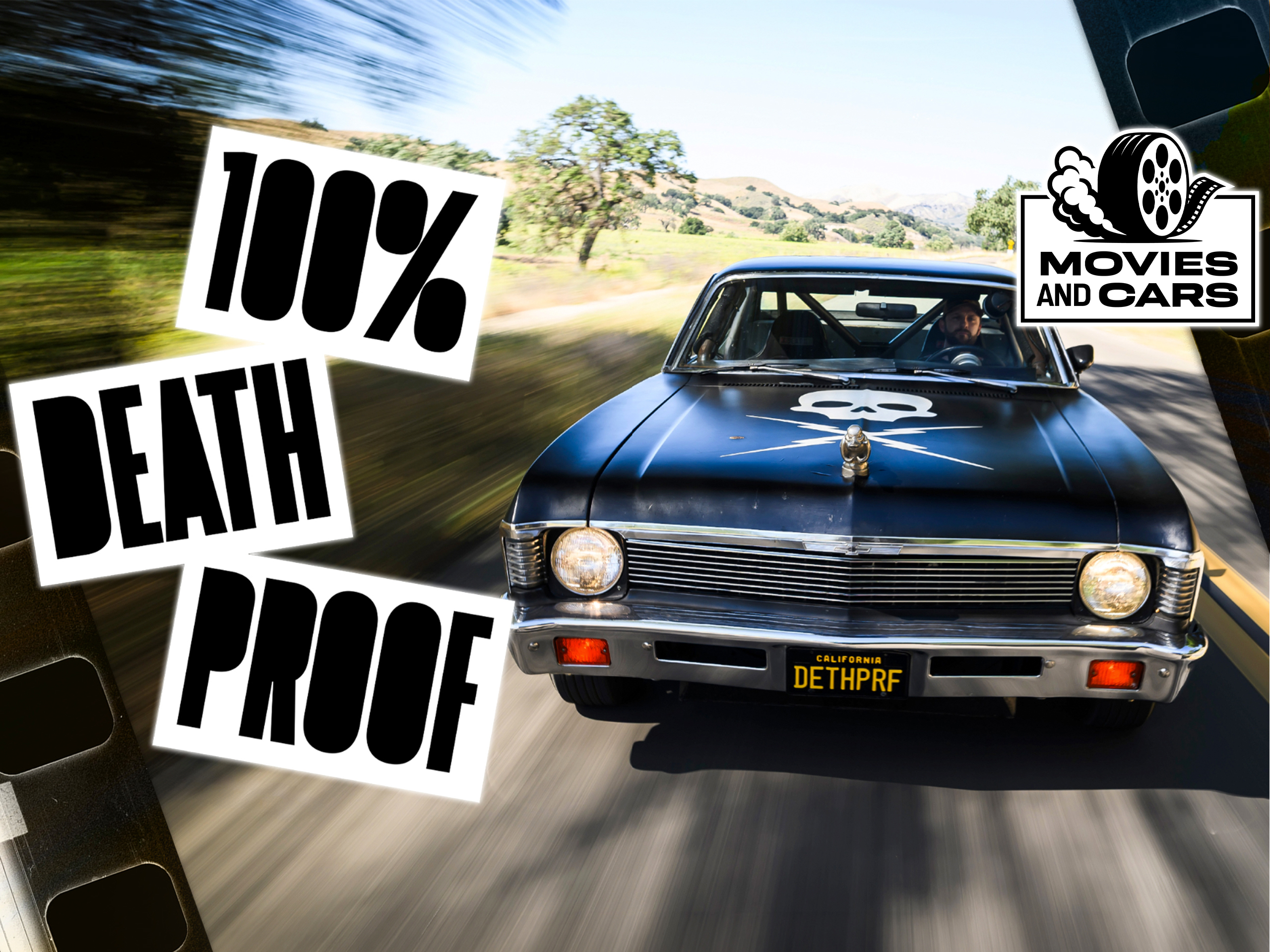
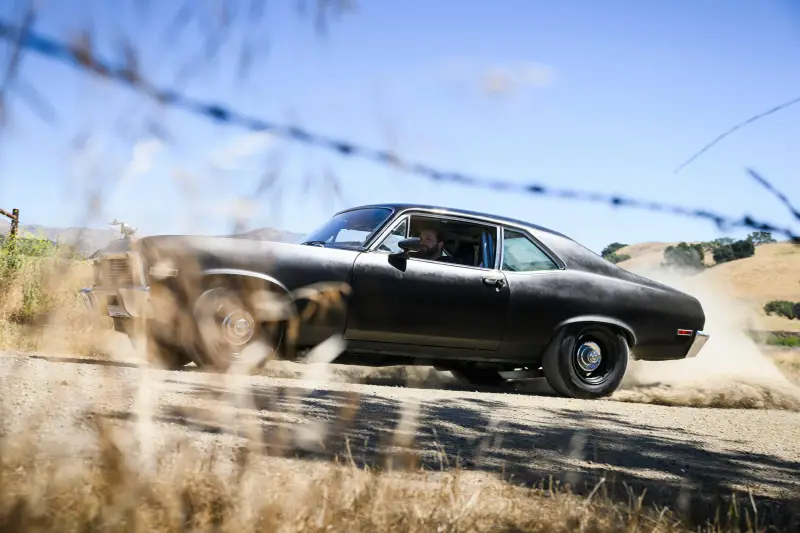
The black 1970 Chevrolet Nova known as The Jesus wasn’t built to imitate a movie car. It was one. Buddy Joe Hooker drove it for Death Proof, Quentin Tarantino’s 2007 film about a stunt driver who uses cars to attack women. The Nova’s battered appearance, skull-and-lightning hood graphic and exposed steel cage all belonged to the working machine, not a replica dressed for a camera.
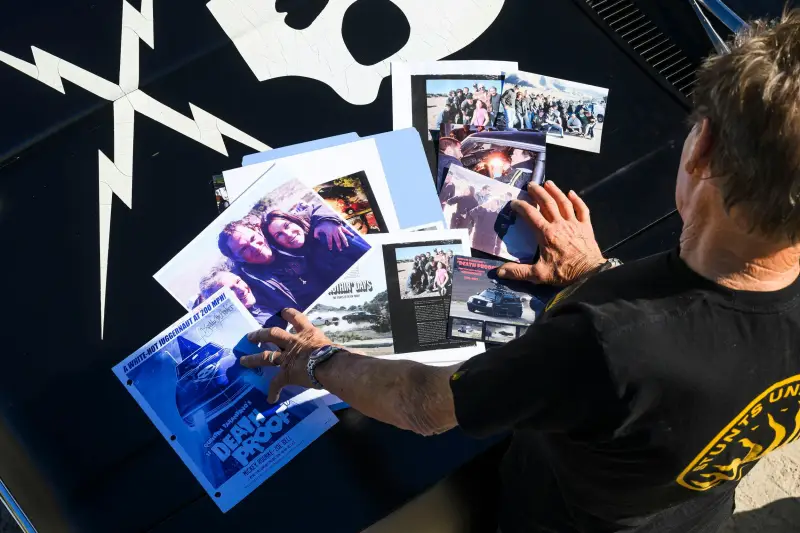
Now the car belongs to the Hooker family. Buddy Joe, an experienced Hollywood stunt driver, kept it after production; his wife, Gayle, and son Kanan have helped maintain it. The result is a curious mix: a stripped-down stunt vehicle with the scars and hardware of its movie work, yet also a family car that Kanan and his twin brother Houston drove as teenagers.
That history matters more than the Nova’s menacing screen image. Its engine and lightened body made it lively, while its modified brakes, cage and spartan cabin reflected the job it was built to do. On the road, it behaves less like an invincible movie villain than a powerful, old-fashioned muscle car that rewards careful inputs.
A stunt car that looked the part
Tarantino wanted Death Proof to draw on the rough-edged car films of the 1960s and 1970s. The production relied on practical driving and physical effects, with Hooker selected as the principal stunt driver and Kurt Russell’s double. That approach put the cars, their drivers and the vehicle crew at the center of the work. The Nova had to be convincing on screen because it was doing real stunt driving, not simply standing in for a more capable machine.
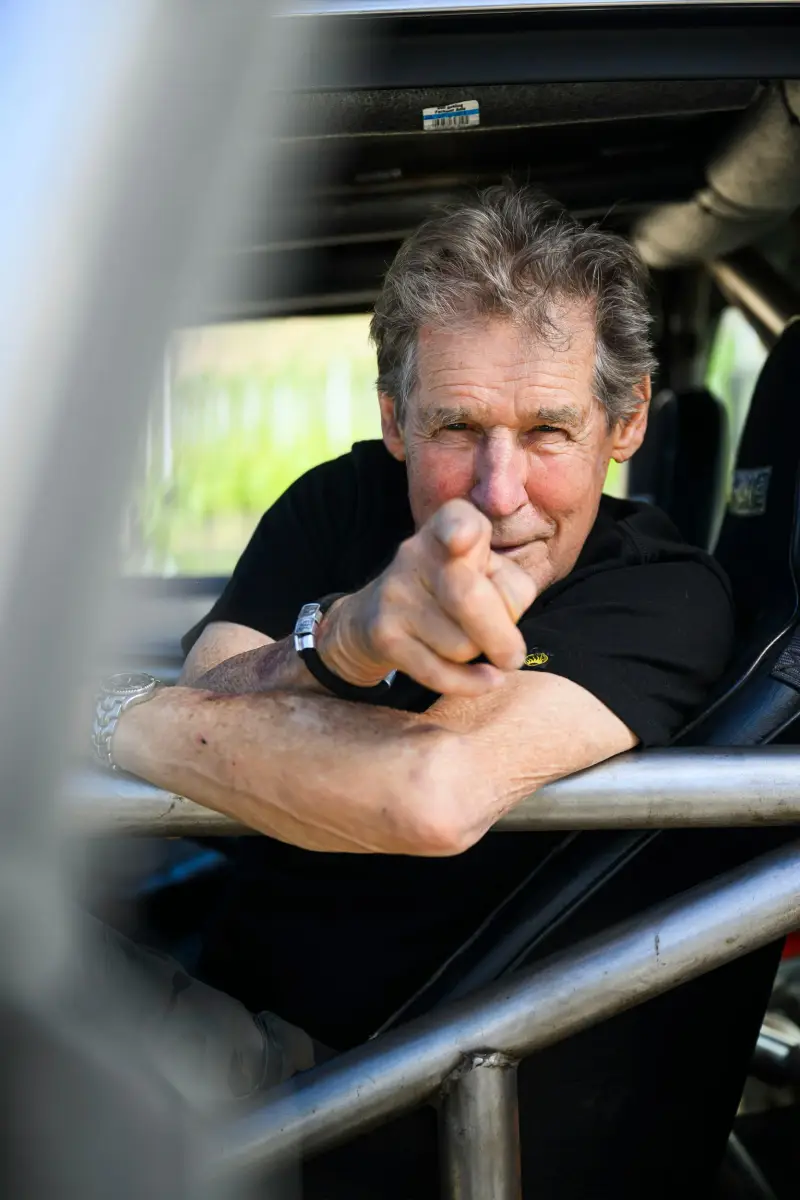
Hooker had spent decades doing demanding vehicle work before the film. His credits include Close Encounters of the Third Kind, To Live and Die in L.A., Scarface, Harold and Maude, Terminator 2: Judgment Day, Days of Thunder and the 2000 version of Gone in 60 Seconds. Earlier jobs had him jumping a motorcycle over the spinning blades of a landing helicopter for Daredevils, rolling a truck 17 times down a sandy slope for Clay Pigeon, and sending a car roughly 120 feet over Burt Reynolds and into the Arkansas River for White Lightning.
The production acquired and prepared three Novas: one for close-up work and two for stunts. One stunt car, called The Cleetus, was assigned to a major roll. The Jesus, meanwhile, became Hooker’s preferred car. He says its 350-cubic-inch V-8 had been stroked to 383 cubic inches and paired with long-tube headers and a four-barrel carburetor. It had useful power and, in his view, handled better than the other Novas.
Hooker took a liking to The Jesus early, an uncommon attachment for a car he was expected to use at work. He also tried to keep it out of harm’s way when the production’s bigger action scenes were being set up. The joke has a practical edge: a stunt car can be expendable by design, but the better it works for a driver, the more reason there is to preserve it for the next shot.
The other stunt Nova, The Cleetus, took the punishment in the film’s cannon-roll sequence. The method used a tube mounted under the car, packed with a section of telephone pole and black powder. At the right moment, the driver triggered the charge. The pole shot down into the ground, broke apart and lifted the car into a series of sideways rolls.
Hooker operated the trigger while driving. He describes taping the detonator to his thumb so he could keep both hands on the steering wheel. For the take, The Cleetus rolled about 160 yards, then slid on its roof to a stop close to the camera. Hooker got the shot on the first attempt. That left The Jesus intact, and after filming he asked Tarantino to let him keep it. The director sold it to him for about $500.
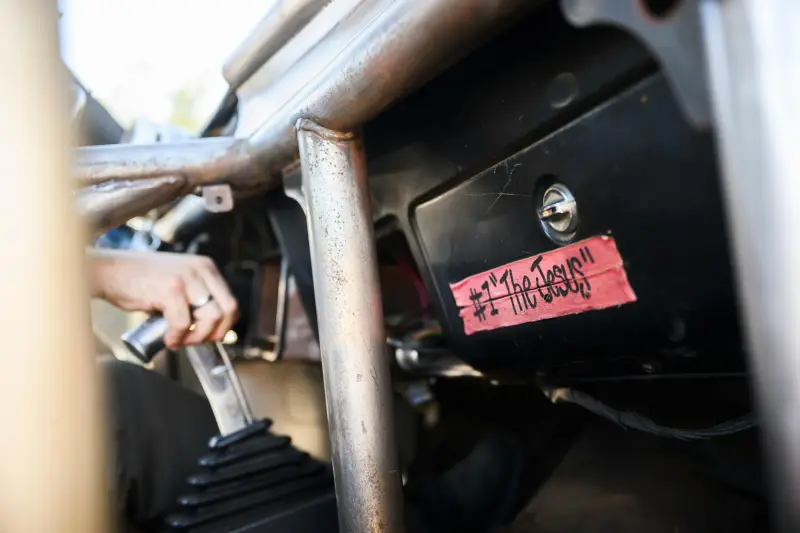
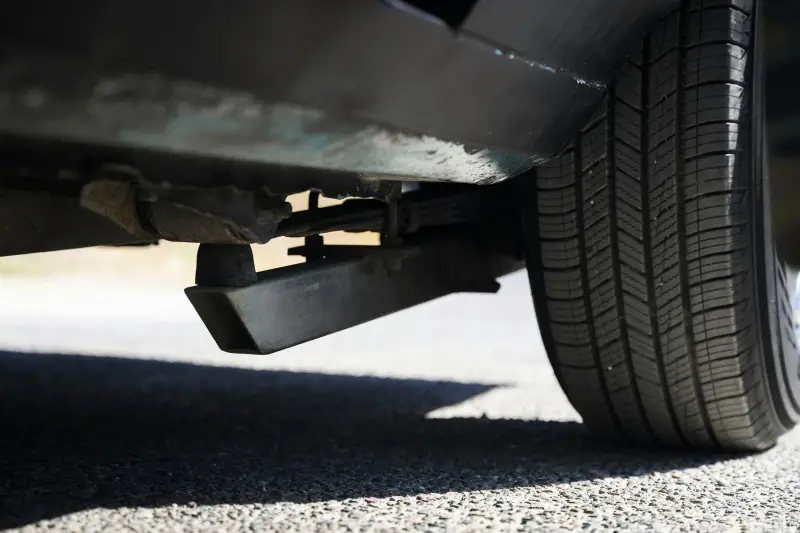
On screen, the cannon roll makes the car seem almost disposable. In the Hookers’ garage, the survival of The Jesus became part of its story. The production’s needs explain much of what is unusual about the car: a roll cage that remains visible, stripped interior trim, a fuel cell in place of the original tank, and controls arranged to support stunt maneuvers.
From set car to family Nova
Buddy Joe’s twin sons, Kanan and Houston, later worked on the Nova and drove it to high school near the Snake, a winding stretch of Mulholland Drive in Los Angeles. The car had already been heavily used during filming, so the brothers refreshed engine components. They also added steel inner panels to the doors. The production had left those areas open to reduce weight and limit the risk of dangerous loose material, but closed panels made more sense for the car’s life with the family.
They removed the Plexiglas divider between the driver and passenger areas and took out the tractor-style seat used by Rose McGowan’s character. In the film, she is trapped in a crash enclosure while Stuntman Mike brakes hard. For ordinary use, the Hookers replaced that seat with a conventional one. These changes shifted the car away from a dedicated film setup without erasing its defining equipment.
The brake system also carried over a stunt-specific arrangement. During filming, the main pedal operated the front brakes, while a second pedal near the dead pedal controlled the rear axle. That layout let Hooker spin the Nova and perform 180-degree turns. Kanan says the family kept the extra pedal briefly for messing around, then returned the brakes to a more conventional arrangement because the setup didn’t suit day-to-day driving. The remaining change was a larger brake booster from a Chevrolet C/K truck.
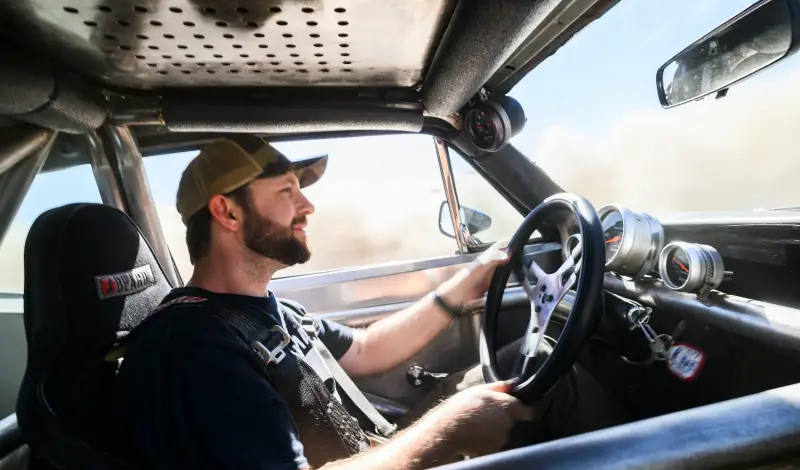
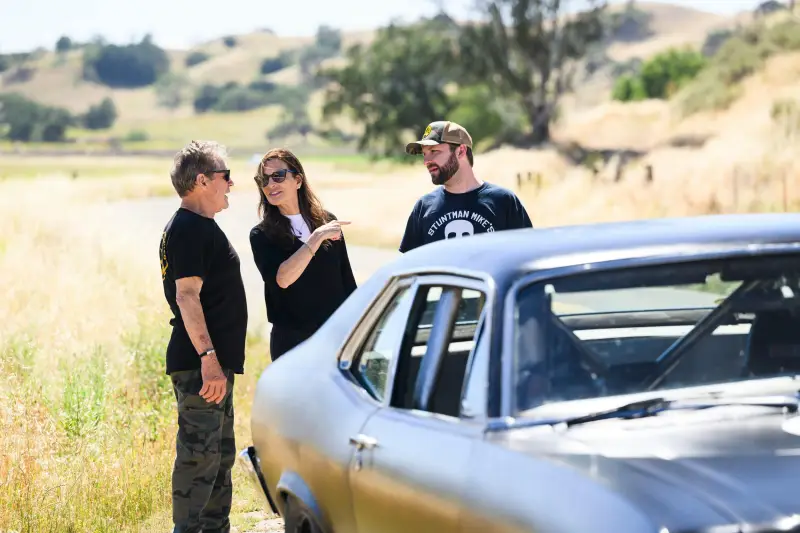
Kanan, now 33, works for onX Offroad, a Montana-based off-road mapping technology company, and is no longer in the stunt business. Getting the car ready for a photo session near Buellton, California, brought back the period when he and Houston were growing up around their father’s work. He remembers helping get the Nova running as a teenage gearhead; sorting it again decades later felt like revisiting that time.
Gayle says the boys’ familiarity with cars came with years of karting and instruction from people in the stunt community. Buddy Joe and Gayle had watched their driving develop and trusted their sense of space, timing and vehicle movement. That confidence was personal, but the Nova’s structure also shaped their thinking: it had been prepared to protect its driver during stunt work, and it retained its cage and harnesses after leaving the set.
The family’s relationship to the car grew beyond its mechanics. Gayle remembers Kanan and Houston visiting the production and seeing their father at work. For a school project, the brothers made a film that cast the Nova as a protector. What audiences saw as Stuntman Mike’s sinister weapon became, for the family, a link to their father’s career and a fixture in their own memories.
What it’s like behind the wheel
The Nova’s interior makes its purpose clear as soon as a driver climbs in. A horizontal cage bar runs just inside the door, and another padded bar sits beneath the roof. Getting into the fixed bucket seat means stepping over steel and lowering into a compact space. Kanan warns visitors to move carefully around the turn signal, which can be knocked off during the climb.
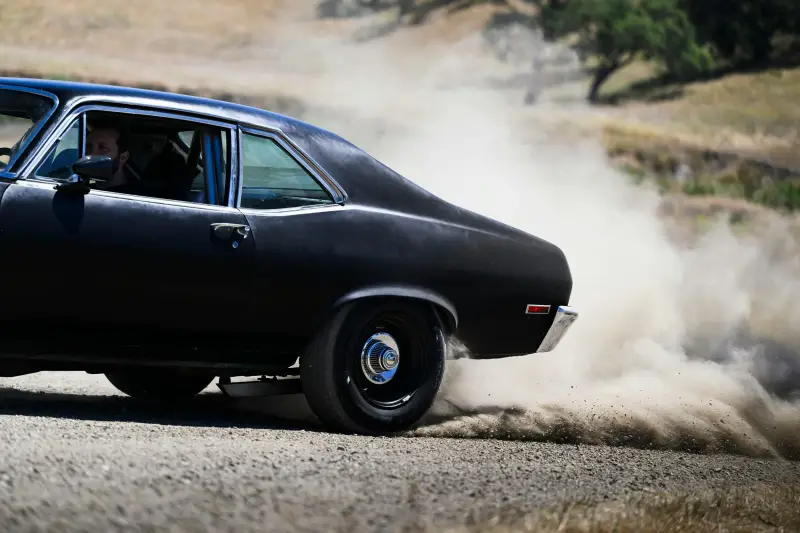
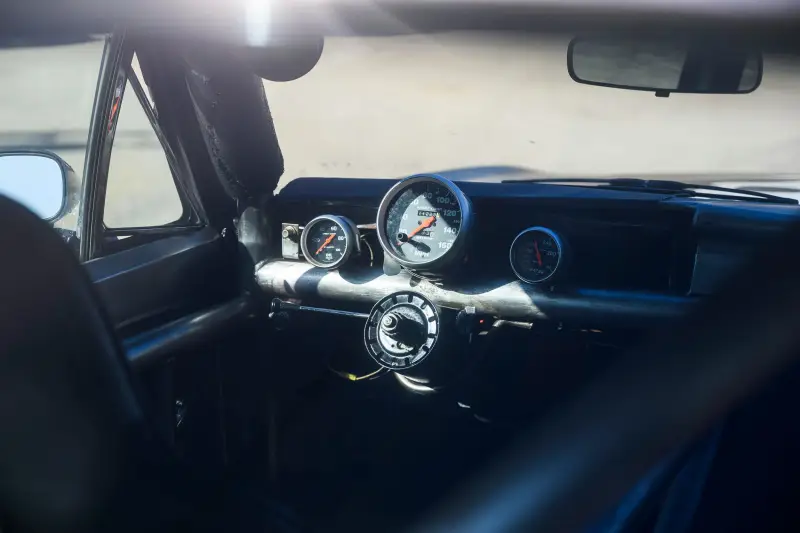
Both seats have five-point harnesses. The dashboard and rear seat are gone, and a drilled steel panel reinforces the roof where the headliner would normally sit. The production crew had considered the roof’s ability to withstand the long inverted slide in the cannon-roll sequence. A quick-release steering wheel makes entry easier, while three gauges above its hub provide speed, oil pressure and water temperature. The tachometer sits on a bracket near the upper windshield, and wiring remains exposed beneath the steering column.
There’s little attempt to make the car feel refined. The 383 V-8 starts with a bark before settling into an idle, and the cabin passes along engine noise, rattles and vibration with little sound insulation to soften them. That was part of the point for filming: the engine, the driver’s workspace and the automatic shifter all had to produce real sounds. The result is an interior that feels close to the car’s mechanical work, not separated from it by layers of trim.
The gearbox is a GM four-speed automatic with overdrive, controlled by a metal B&M shifter. Hooker preferred automatics for stunt driving because they left him freer to manage the car. That preference is easy to understand in a vehicle where steering, throttle and timing may all need attention during a maneuver. For an everyday driver, the transmission also makes the Nova less demanding to move at low speed than a manual might be, though it doesn’t change the old car’s direct, mechanical character.
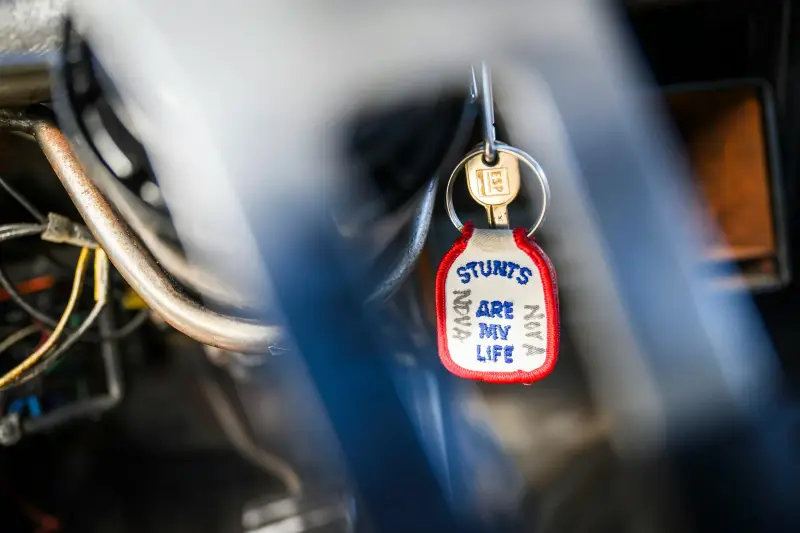
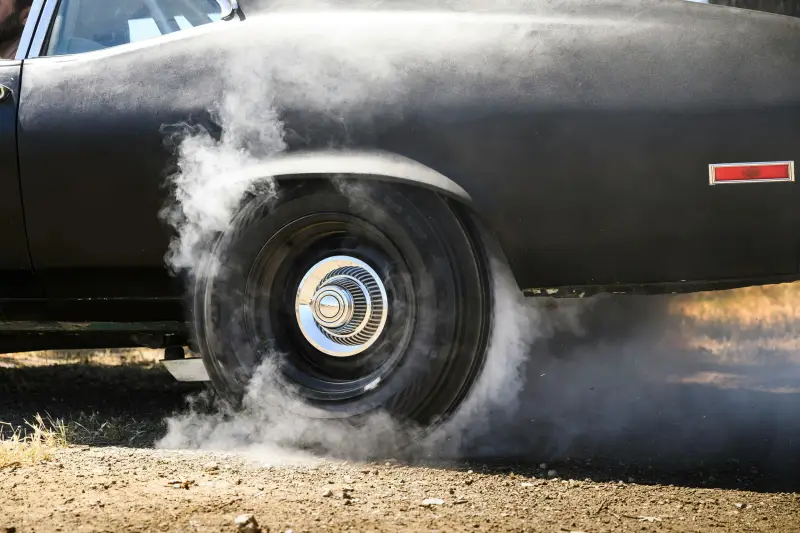
Apply the throttle on an open stretch and the Nova spins its rear tires through first and second gear without much coaxing. The small-block’s output is familiar territory for a modified V-8; the more revealing part is how little car it has to move. A stock Nova weighed a little over 3,000 pounds. With the interior stripped and the original fuel tank replaced by a 10-gallon fuel cell, this one is closer to 2,800 pounds.
That reduction helps explain why the car feels so eager, but it also affects balance. The rear axle carries less weight than a fully trimmed street car, and the suspension is largely standard apart from the rear traction bars. On a winding road, weight transfer can catch a driver out, especially if the automatic shifts while the car is loaded up in a turn. Kanan advises smooth corner entries, avoiding excess demand on the front tires, and using the left foot on the brake rather than abruptly lifting off the accelerator mid-corner.
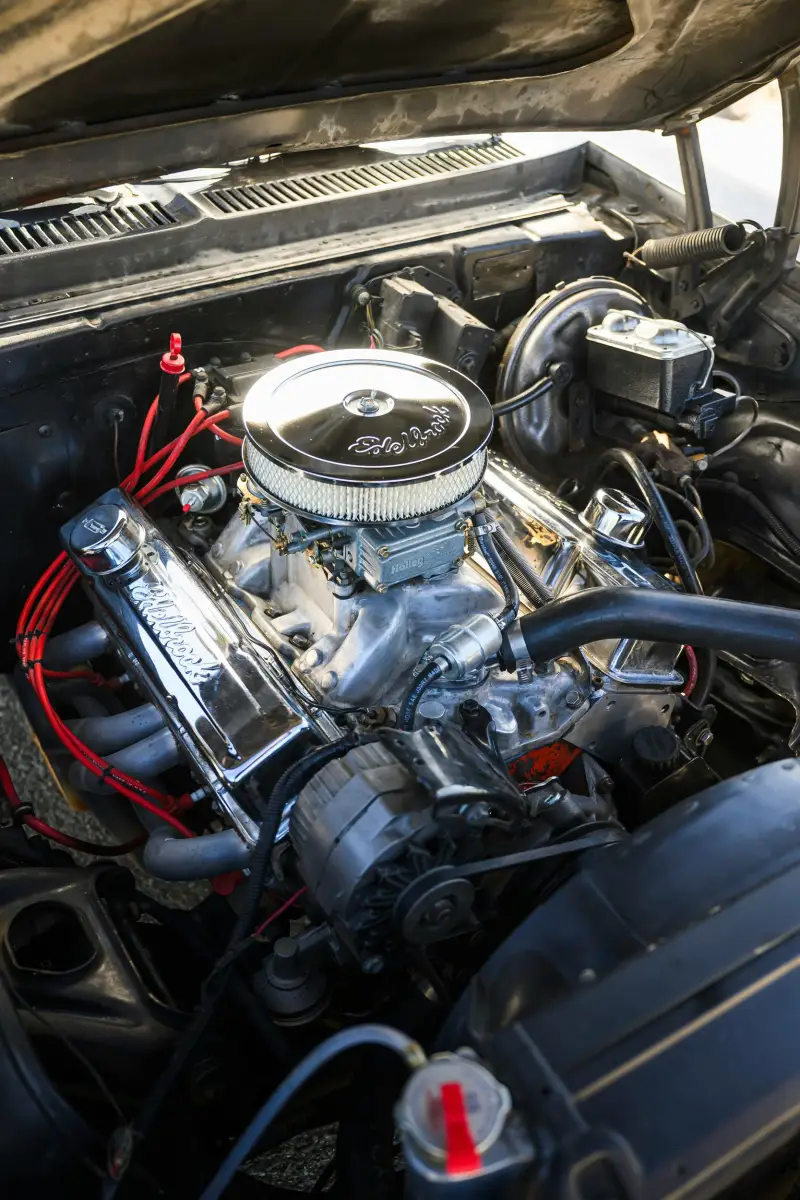
The steering is initially vague around center. After a little movement, the truck-spec power assistance comes in and the front wheels begin to follow more readily. At speed, the Nova tracks straight, but the driver needs to make small corrections before the steering settles into a rhythm. The drum brakes demand a firm press before they bite, so following distance matters. Those are useful ownership details behind the car’s film-ready spectacle: it has ample power, but it doesn’t respond like a modern performance car.
The V-8’s dual Flowmaster exhaust adds a low burble, and the engine has enough torque to make the car feel strong without needing to be driven hard. The trade-off is that this is a light, old car with an unusual history and a cabin built around a cage. Its film equipment makes it distinctive, yet a driver still has to respect its brakes, steering and changing weight on uneven or winding roads.
Real stunts, real coordination
Hooker describes the stunt work as a matter of preparation and survival. He says he never went into a job believing it would kill him; the point was to plan the work so he could get through it. Gayle makes a similar point from the production side: drivers, performers and crew rely on one another, and a failure in coordination can have serious consequences. A few seconds of footage can be the result of weeks of planning.
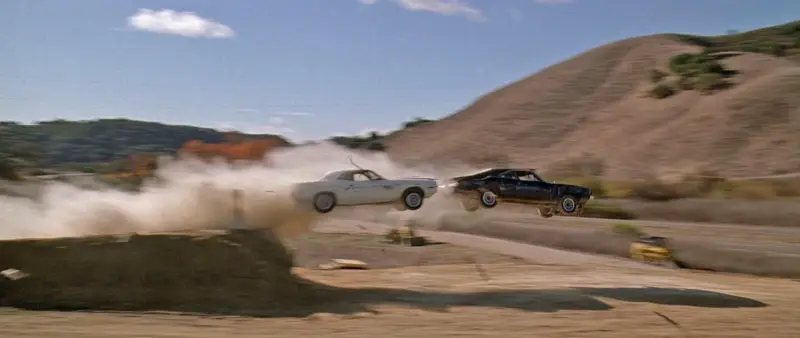
The final chase in Death Proof shows why that care mattered. Its black Charger and 1970 Challenger repeatedly make contact on country roads, with stuntwoman Zoë Bell riding on the Challenger’s hood. Tracy Keehn-Dashnaw drove that car. Bell’s restraint was a cable attached to her harness and routed through the hood, with a crew member in the rear seat controlling the line through pulleys.
Hooker drove the Charger and says the sequence made him more uneasy than some of his other work. He had substantial steel around him. Keehn-Dashnaw had to consider Bell on the hood, while both drivers had to work around aging cars whose axles or wheels might fail. The crew had to account for that uncertainty as it planned impacts and repeated takes.
Tarantino wanted Hooker to come alongside and strike the Challenger. Hooker was reluctant to hit it as hard as requested because a damaged front wheel could cause the car to flip. Bell, meanwhile, could turn and throw her legs after each impact to make the contact look more violent. Hooker credits her performance for selling the force of the hits, and he praises Keehn-Dashnaw as one of the strongest drivers he worked with.
The two drivers built a shared sense of timing. Keehn-Dashnaw and Hooker knew how each other would move as Tarantino asked them to increase speed and impact. That coordination let the sequence grow in intensity while keeping both vehicles’ actions legible to one another. The work relied on their driving as much as on the cars’ appearance.
For the climactic collision, Hooker had to bring the Charger down a lower road while Keehn-Dashnaw drove the Challenger down a ridge. The impact needed to land at a chosen point where the camera car could capture it. The road was wet where the cars met, and both spun out, a result that wasn’t planned. Tarantino liked the accident and asked the crew to reproduce it. The drivers then had to make the unexpected movement repeatable enough to film.
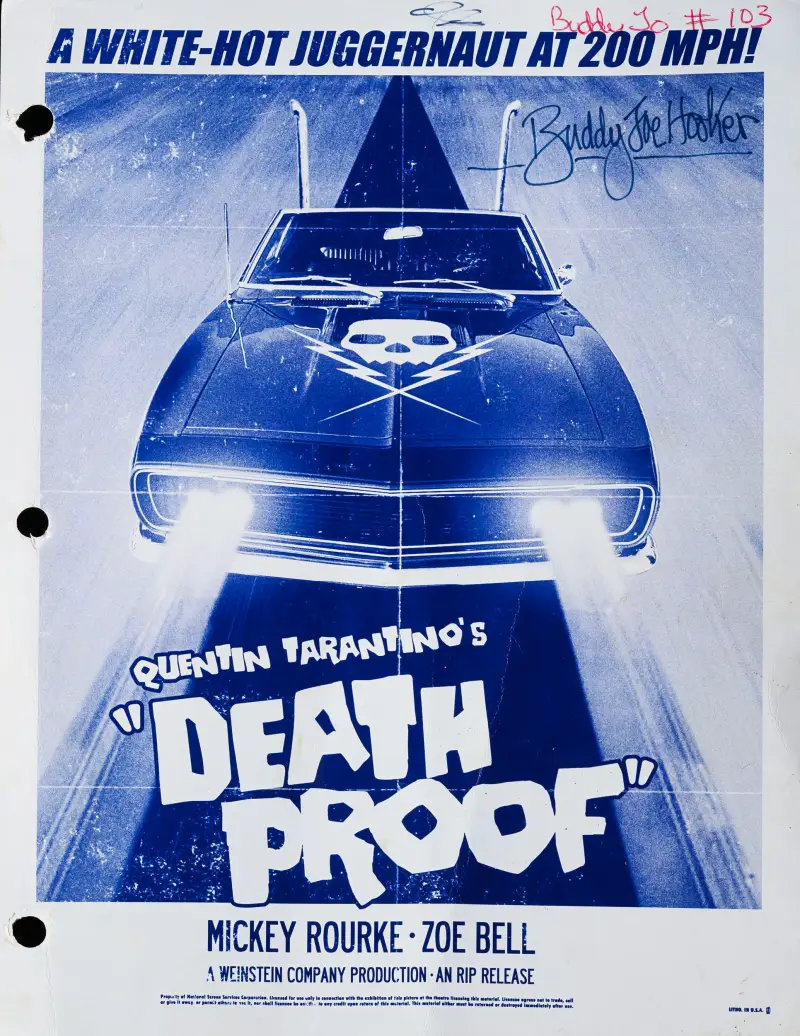
That balance of risk and control is easy to miss when the finished scene is cut together. Stunt drivers rarely become the public face of a movie, but their work is visible in the physical behavior of the cars: how a vehicle turns, how an impact lands, and whether a maneuver can be repeated for another camera angle. In Death Proof, the Nova’s cage, stripped cabin and loud mechanical character make that work part of the film’s texture.
A movie villain’s car, a family keepsake
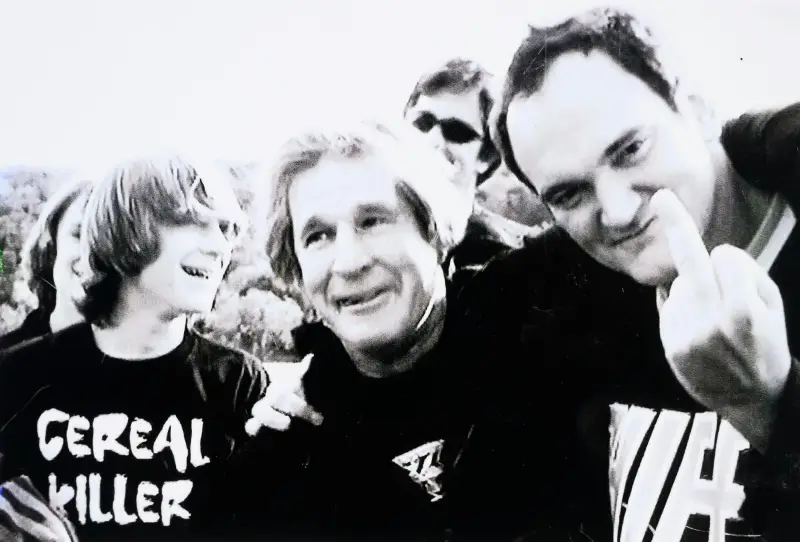
The Nova’s two identities sit side by side. For viewers, it’s the matte-black machine associated with Stuntman Mike. For the Hookers, it carries memories of Buddy Joe’s work and the boys’ time around the production. It’s the car Kanan and Houston helped maintain, the vehicle they took to school, and the centerpiece of a family story that grew out of the set.
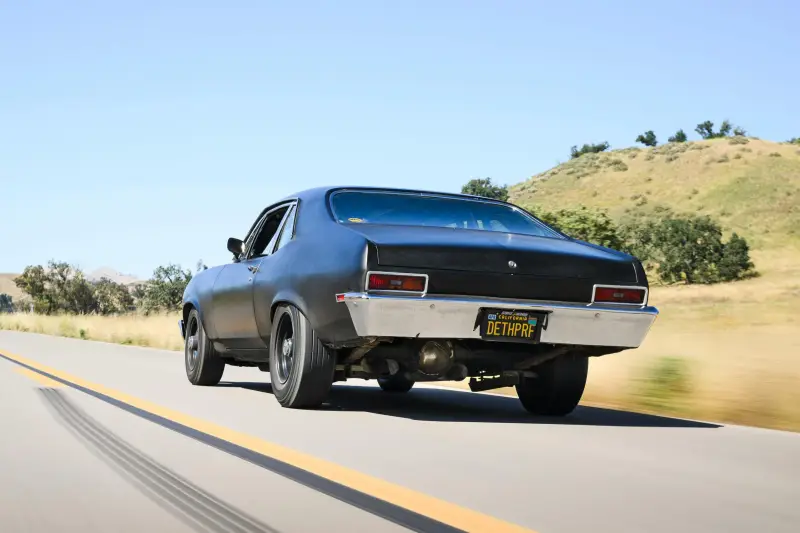
Driving it makes the screen persona feel less supernatural. The Nova is powerful and dramatic, but it’s also a roughly 2,800-pound car with period suspension, drum brakes and steering that asks the driver to work with it. Its cage and harnesses speak to the demands of stunt work; its ordinary mechanical limits remain just as clear. The car’s appeal comes from holding those facts together.
Hooker’s answer to the suggestion that stunt drivers must want to die is simple: he says he has a “life wish” and a “survival wish.” The distinction suits The Jesus. It was built to make dangerous action look convincing, with a driver and team preparing each move carefully. Decades later, the same car remains most compelling as a piece of working automotive history—still loud, still distinctive, and now firmly rooted in the family that kept it.