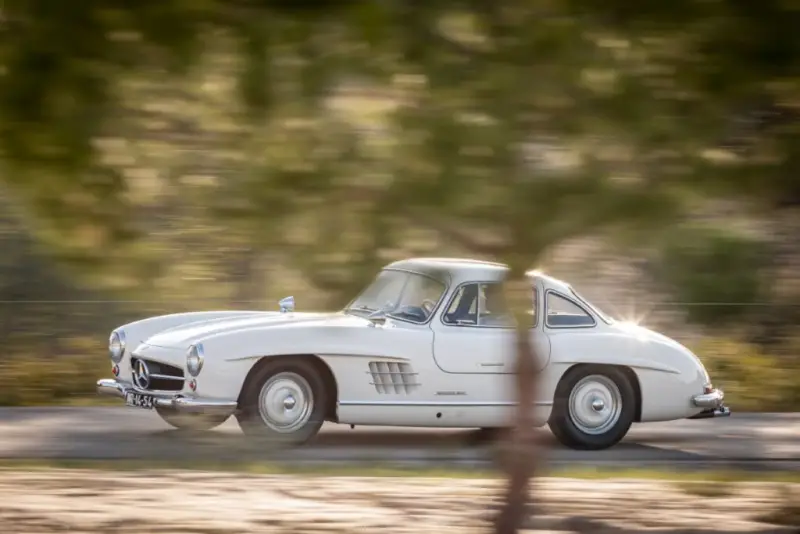
Mercedes-Benz 300SL Gullwing at 70: Racing Roots, Road Manners and Lasting Appeal
Electric Vehicles Richard Heseltine 599 reads
Born from a successful racer, the 300SL Gullwing paired 1950s speed with striking design—and kept some demanding quirks.
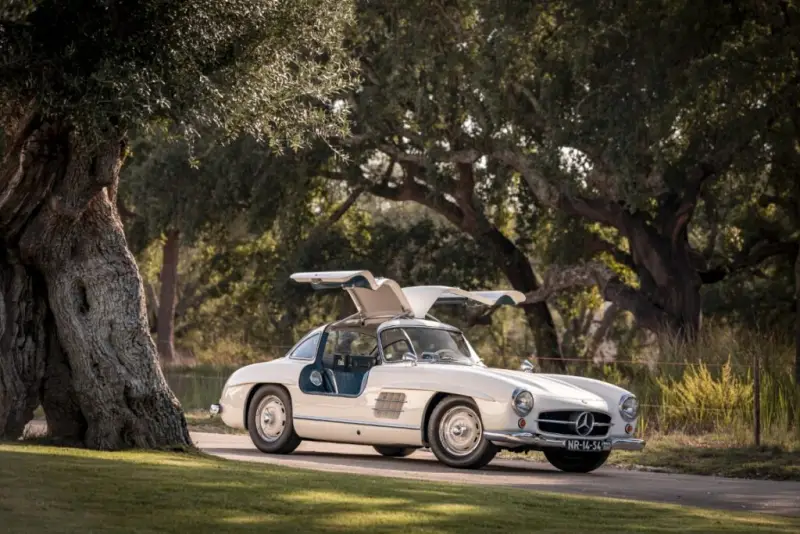
Seventy years on, the Mercedes-Benz 300SL Gullwing still makes an entrance before it turns a wheel. Its shape is the headline, but the car’s lasting appeal comes from a more interesting mix: racing success, a road-going engineering first, genuine pace and handling that asks its driver for care. The beauty has never told the whole story.
The road car nearly didn’t exist. Its starting point was a competition machine built as Mercedes-Benz prepared a limited return to racing. The company was rebuilding its sporting presence, and the 300SL was intended to prove the marque’s capabilities on track. A persuasive American dealer saw a second purpose in it: a striking sports car that could raise interest in a more affordable model.
A racer with a short, successful career
Chief engineer Rudolf Uhlenhaut began work on the W194 SL after receiving approval from the Daimler-Benz board in June 1951. Its tubular spaceframe was notably light, weighing 82kg, and the sleek body was designed to cut through the air. The original car’s drag coefficient was reported as 0.25, though later changes to the cooling system raised it.
Power came from a 3.0-litre straight-six. The engine wasn’t especially potent by the standards of the car’s mission, yet the SL could reach around 160mph. Its first competition outing came at the 1952 Mille Miglia, where it missed victory but secured second, third and fourth places. At a support race for the Swiss Grand Prix in Bern, Mercedes-Benz took the top three positions.
Le Mans brought a tougher test. Mercedes-Benz returned to the 24-hour race after 22 years away, facing teams from Jaguar, Ferrari, Lancia and Cunningham. The works coupés had been fitted with roof-mounted air brakes, which were removed before the race. The result was a first-and-second-place finish for Mercedes-Benz. The air-brake idea would later reappear on the 300SLR, which Stirling Moss drove to victory in the 1955 Mille Miglia.
The W194’s final competition appearance came at the 1952 Carrera Panamericana. Karl Kling and Hans Klenk won at an average speed of 103mph, while team-mates Hermann Lang and Erwin Grupp finished second. Three victories from four starts made for a brief but persuasive record. The racing programme had done its job; a road car was a separate possibility.
Max Hoffman makes the case for a road car
That possibility became a production plan because of Max Hoffman, Mercedes-Benz’s influential East Coast concessionaire. He argued that a civilised version of the SL would find buyers and could draw attention to the 190SL, the more affordable sports car he wanted the company to build. Accounts differ on the size of Hoffman’s proposed commitment: some say he guaranteed purchases of 1,000 cars, while others put the number lower.
Hoffman had already arranged for a racing SL to appear at American motor shows in 1953 to gauge interest. The production version was still being developed when it was shown at the International Motor Sports Show in New York in February 1954. Three months earlier, the display car had been little more than a bare chassis. Its appearance at the show captured a design in progress, rather than a finished production specification.
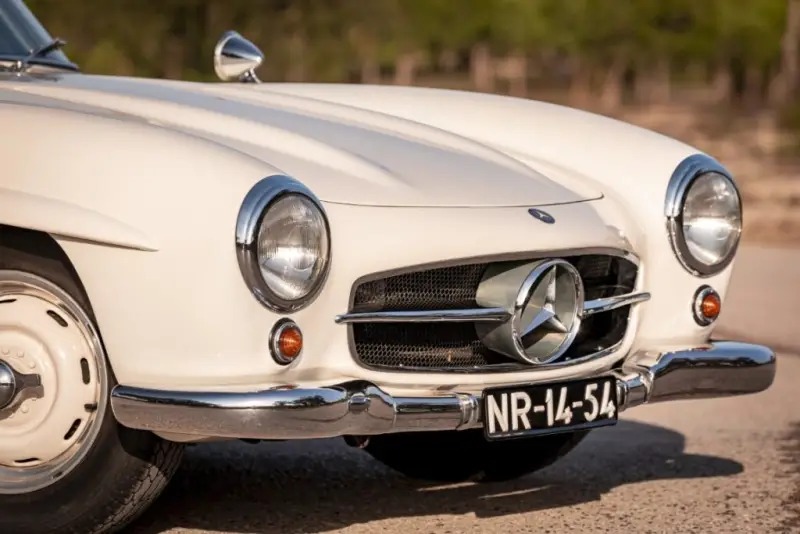
The transformation from racer to road car was more than a matter of adding trim. The racer’s central air intake became part of a wider grille, and angled openings behind the front wheelarches helped release pressure from under the bonnet. The headlamps moved forward and higher, the flanks gained deeper contours, and sweep-shaped details above the wheelarches sharpened the profile. Friedrich Geiger shaped much of the final outline under the supervision of Walter Häcker.
Production equipment and chrome made the car heavier in the air, too: the road-going Gullwing’s drag coefficient rose to 0.425. Under the body, however, its racing ancestry remained clear. Much of the original latticework chassis was retained, with added structure and mounting points for series production.
Fuel injection and formidable pace
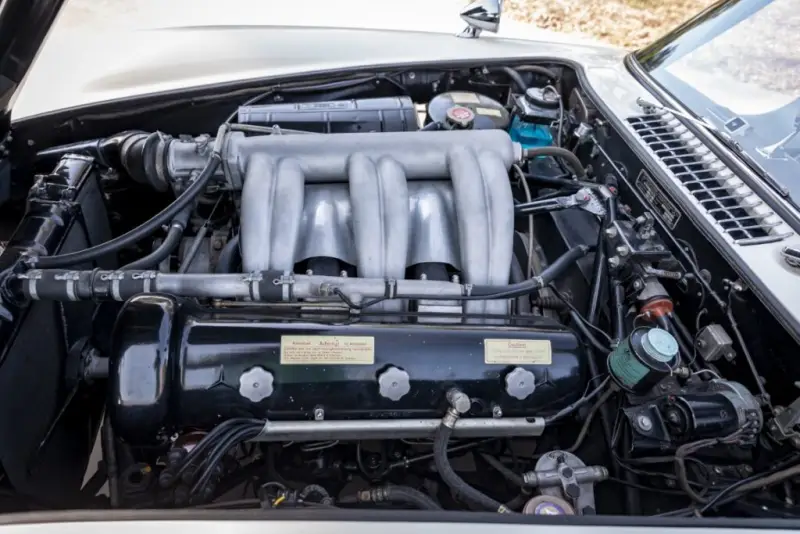
The road car outpowered the racer it followed. Its 2,966cc overhead-cam straight-six used direct fuel injection, making the Gullwing the first production car equipped with the system. Output was 215bhp, sent through a fully synchronised four-speed gearbox and a ZF limited-slip differential. Mercedes-Benz quoted a top speed of 140mph in real-world conditions and a 0–60mph time of 7.7 seconds.
Higher-performance options were available, including specifications described as competition equipment, but the standard car was already exceptionally quick for its time. Contemporary family saloons could struggle to keep pace. The 300SL’s speed was not simply a number on a specification sheet: it gave the car a breadth of ability that could still impress in a later road drive.
Its weaknesses were just as real. The large drum brakes had ample aluminium finning, but their stopping performance didn’t match the engine’s pace. The rear suspension, with swinging half-axles, could produce abrupt behaviour as the car leaned and the wheels moved. Optional stiffer springs and dampers reduced wheel travel, but didn’t remove the challenge. A driver unfamiliar with the car could find a sudden avoidance manoeuvre especially difficult to manage.
That reputation followed the 300SL, despite evidence that experienced drivers could make it work. John Fitch finished fifth in the 1955 Mille Miglia, and the model also found success in rallying. Production ended in 1956 after 1,400 cars had been built. Among them were 29 special-order examples intended for competition, with aluminium bodies that cut 80kg from the standard car’s 1,160kg dry weight. Daimler-Benz also experimented with a glassfibre body.
The next 300SL adopted a low-pivot rear axle, and disc brakes arrived in 1961. Those changes underline how much the Gullwing’s early suspension and braking demanded of its driver. Its engineering was forward-looking, but the car’s road behaviour still reflected the compromises of its period.
Living with the Gullwing’s compromises
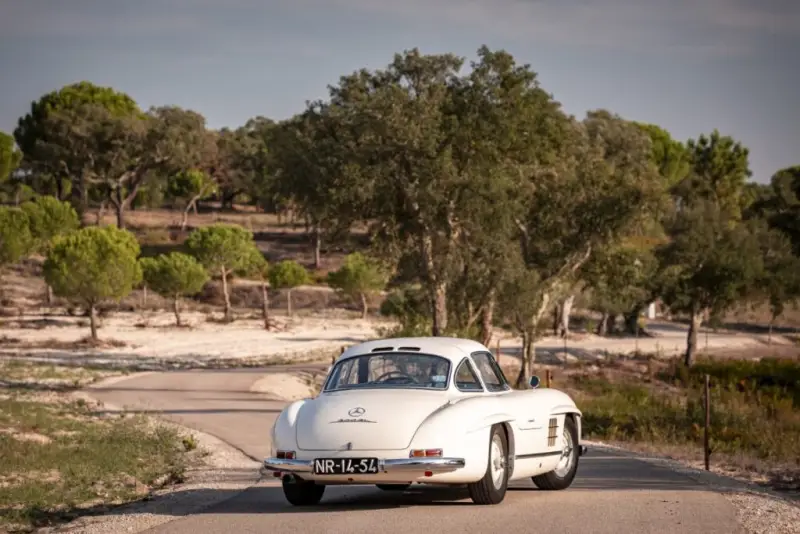
One example, chassis 55000563, offers a close look at the car’s appeal and its practical limits. It was delivered new to Sweden on 30 July 1955, later went to the United States and arrived in Portugal 20 years ago. Today it belongs to a private collection. Its centre-lock wheels and splined Rudge hubs suit the car so well that the standard-looking alternative seems incomplete to many enthusiasts.
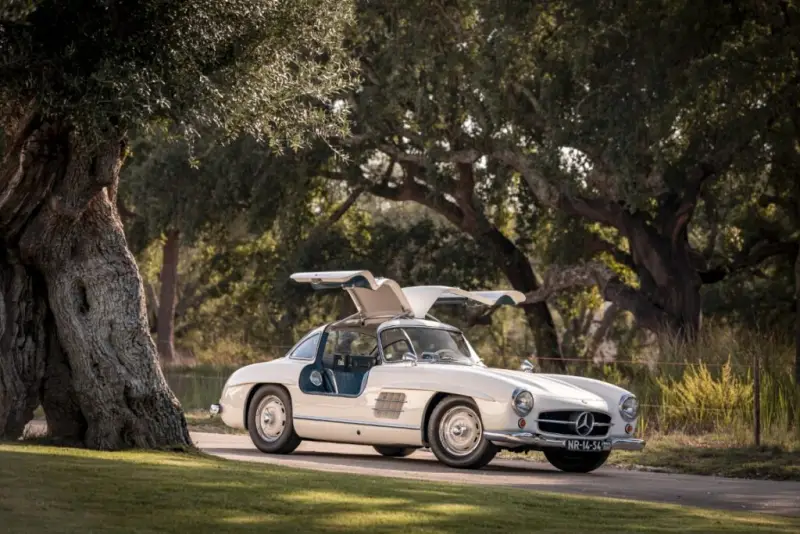
The doors have become the Gullwing’s signature, but they weren’t designed simply to make a spectacle. Their short, raised openings left space in the sills for triangulated bracing around the cockpit, helping stiffen the chassis. The structural solution created a memorable silhouette and a practical obstacle at the same time: getting in takes planning. The wide sills are in the way, though the steering wheel hinges to make the manoeuvre easier. Sliding fully onto the seat before bringing the legs inside is the sensible approach.
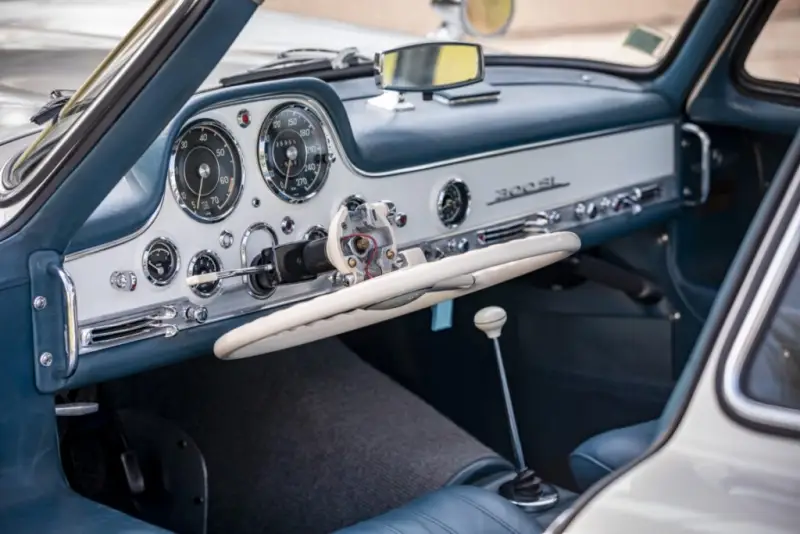
Once seated, the cabin feels roomy in several ways. Large windows provide close to 360-degree outward visibility, the seats are generous and the pedals aren’t awkwardly offset. The painted dashboard and prominent speedometer and tachometer place the interior firmly in the 1950s, while keeping the main instruments easy to read. The gear lever sits within easy reach.
Ventilation is less successful. Opening quarterlights offer limited relief, and the side windows can be removed from outside the car. Heat becomes especially noticeable when the doors have remained shut. It’s a worthwhile ownership detail: the Gullwing can be comfortable in its seating and ride, but a warm cabin is part of the experience.
Quick, communicative and demanding at the limit
At low speeds, the controls feel heavy. The steering, clutch and brakes all need more effort than a modern driver might expect. The change in character comes with speed. The engine pulls strongly, and its smooth delivery makes acceleration feel composed even as the scenery begins to blur. The gearing is fairly high at 25mph per 1,000rpm, but there’s enough torque to keep the car moving with conviction.
Between 2,000rpm and a self-imposed 5,500rpm redline, the straight-six builds speed with little drama. The engine note grows more metallic and racy as the revs rise. The gearbox has a positive, precise action, and the clutch is progressive without requiring excessive effort. At speed, the steering becomes more alert, with about two turns from lock to lock. There’s a small dead area around straight ahead, but the car doesn’t wander.
The spaceframe also gives the 300SL a ride quality that can surprise. Its stiffness allows relatively soft suspension, at least without the optional competition springs and dampers. The result is a car that can feel composed on a longer drive, rather than relentlessly harsh. There’s even the sense that it could cover serious distance, provided luggage fits behind the seats and the cabin heat stays manageable.
Braking and cornering are the exceptions to that otherwise easy rhythm. The pedal feels wooden and heavy, offering little confidence. At the limit, the rear can become unsettled quickly, particularly through a corner with a tightening radius or changing camber. A driver new to the car may find that its communication disappears just when it matters most.
Experienced drivers describe a more adjustable car. A measured entry, restrained braking and smooth power on the way out suit a cautious approach. With practice, throttle input can help manage the tail, but that technique requires confidence, quick reactions and plenty of space. Most Gullwings are unlikely to see that kind of hard driving today; at ordinary road speeds, their pace and personality are easier to enjoy.
That dual character explains why the 300SL’s reputation includes both glamour and difficulty. It looks extraordinary among its contemporaries, and its gullwing doors remain a piece of functional engineering that happens to be theatrical. Yet its place in automotive history rests on more than appearance: it was fast, technically ambitious and built from a successful racing design. The brakes and rear suspension ask for respect, while the engine, ride and steering reward a sympathetic driver.
The Gullwing’s flaws don’t diminish its achievement. They make the car more than a polished object to admire. It can charm at a standstill, cover ground with surprising ease and remind its driver that pace demands judgment. Seventy years later, that combination is still the point: the 300SL is a beautiful car with a very human need to be understood.