Ford Weighs Future Mustang Dark Horse R Development for Single-Make Racing
Electric Vehicles Dylan Spaulding 469 reads
Ford may keep developing the Dark Horse R or base a future spec racer on another Mustang, while expanding the current car’s reach through invitational events.

Ford’s single-make Mustang racing programs have a choice ahead: continue evolving the Dark Horse R or eventually build a spec racer around another Mustang. Ford Racing global director Mark Rushbrook says both paths remain under consideration, with no immediate changes announced. For competitors, the decision will shape the future of a platform designed to put drivers in comparable cars and make setup, racecraft and driving skill count.

The Dark Horse R has anchored Ford’s single-make racing effort since the first Mustang Challenge season in 2024. It underpins Mustang Challenge North America and Mustang Cup USA, and is also set to feature in the Mustang Challenge Global Invitational, which begins in 2027. With the car approaching its fourth season of competition next year, Ford is assessing how the customer racing programs should develop alongside the Mustang lineup.
“We’re always looking at what the right thing to do is in terms of evolving the current car based on the Dark Horse,” Rushbrook told Sportscar365 at Daytona International Speedway last week. “Or whether it would make sense to base another spec car off a different Mustang at some point in the future. You’ll see in the future.”
A platform built around equal equipment
That openness leaves two distinct possibilities: refine the existing Dark Horse R or start with a different Mustang for a future single-make car. Ford hasn’t provided a timetable, named a replacement model or detailed any planned technical changes. For teams and drivers, the current car therefore remains the known quantity, while any change in the platform is a longer-term prospect rather than an announced transition.
Rushbrook’s emphasis is on the sameness of the cars. He said the Dark Horse Rs share the same engine, power, transmission, suspension and brakes. That common specification is intended to put the focus on how each team sets up the car, how each driver handles it and how they compete. The formula gives participants a more direct comparison of performance than a field where different machinery can account for differences on track.
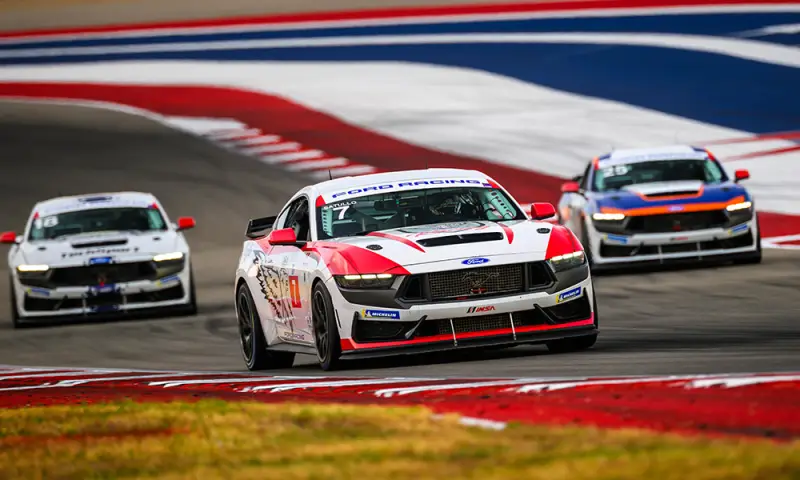
That kind of parity can make a series easier to follow as well as more accessible to drivers with varied backgrounds. When the basic equipment is shared, preparation and execution become clearer parts of the contest. The car still needs to be set up for the driver and conditions, but the competition starts from a common mechanical foundation.
Invitational events broaden the car’s role
Ford has also used invitational events to put the Dark Horse R in settings beyond its regular championships. The recent Ford Proud To Honor: Veterans Day Classic at Daytona International Speedway brought together six teams, each with two cars. Ford Racing drivers and competitors from different disciplines took part, with teams representing branches of the U.S. military through specially designed liveries.
The format paired drivers with different experience and racing backgrounds in the same type of car. Rushbrook said that equal equipment was part of the appeal: professional drivers could compete in a car unfamiliar to them while facing one another on a shared basis. For Ford, that makes the invitational a demonstration of the platform’s flexibility as well as a race outside the usual championship setting.
“I love the Dark Horse R, Mustang Challenge, Mustang Cup and these invitationals that we do because the cars are equal,” Rushbrook said. He described the shared specification as extending across the engine and power, transmission, suspension, brakes and other components, leaving setup, driving and racing to separate competitors.
International events extend the calendar
The Mustang Challenge platform is also scheduled to travel beyond North America again next year. Mustang Challenge North America is set to appear at the CrowdStrike 24 Hours of Spa, which will be the second round of the Global Invitational. The invitational is due to start at Daytona and conclude with a Mustang Cup Australia round at Bathurst.
That schedule gives the Dark Horse R a role across multiple venues and event formats, including a major endurance racing weekend. It also offers a practical showcase for a car whose appeal rests partly on consistent equipment: drivers from different series can share the same platform even as the surroundings and competition change. Ford has not detailed further changes to the car for these events.
Rushbrook pointed to Mustangs racing across a wide range of disciplines, from Formula 1 and Hypercar to Dakar, as evidence of the model’s reach in motorsport. The Dark Horse R serves a different purpose within that broader activity: it gives Ford’s customer racing programs a shared car for championships and invitationals. The next clear sign of the platform’s direction will be whether Ford announces further development of the current racer or identifies another Mustang as the basis for a future spec car.